Tools
Paint S provides a variety of tools and built-in shapes to help you create and edit images.
Select and Configure Tools
You can select a tool in two ways:
- Toolbar: Click a tool icon in the Toolbar.

- Tool Menu: Choose a tool from the Tool menu. Each tool has a keyboard shortcut based on the
Option(⌥) key.
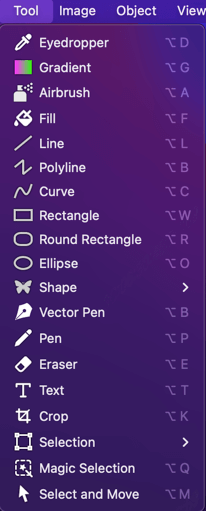
After selecting a tool, you can configure its properties (such as line width or color) in the Attributes Panel. See Modify Attributes.
Tips
You can also draw first and modify the object's attributes later.
Keyboard Shortcuts
Every tool has an Option (⌥) shortcut. Learn these and you can switch tools without leaving the canvas.
| Tool | Shortcut | Tool | Shortcut |
|---|---|---|---|
| Select and Move | ⌥M | Shape, Icon, Emoji… | ⌥N |
| Eyedropper | ⌥D | Vector Pen | ⌥V |
| Gradient | ⌥G | Pen | ⌥P |
| Airbrush | ⌥A | Eraser | ⌥E |
| Fill | ⌥F | Text | ⌥T |
| Line | ⌥L | Crop | ⌥K |
| Polyline | ⌥B | Rectangular Selection | ⌥S |
| Curve | ⌥C | Magic Selection | ⌥Q |
| Rectangle | ⌥W | Elliptical Selection | — |
| Round Rectangle | ⌥R | Lasso Selection | — |
| Ellipse | ⌥O | Polygonal Selection | — |
Tips
The four selection tools share one toolbar button. Pick the one you want from the Tool > Selection submenu, or click and hold the toolbar's Selection button to pop up the menu.
Common Interactions
These behaviors apply to most tools:
- Objects stay selected after you draw them, with control knobs, so you can adjust them right away. Select it again later with the Select and Move tool.
Tips
The Pen, Eraser, Airbrush, and Fill tools are exceptions — they do not auto-select what you draw. This is deliberate: those strokes are meant to be drawn over, not immediately tweaked. To edit one later, pick it from the layer list.
Escis context-aware: while drawing a path it cancels the drawing, and during a move, resize, or transform it restores the object to its previous state.- Press the arrow keys to nudge selected objects by 1 pixel. Hold
ShiftorCommandfor half-pixel steps. - Objects snap to the canvas edges and other objects by default. Hold
Optionwhile moving or resizing to temporarily invert this behavior. See Settings. - Right-clicking an object opens a context menu with the most common edit commands. With the Select and Move tool, right-clicking also selects the object.
- Hold
Spaceand drag to pan the canvas; holdSpaceand scroll to zoom. See Canvas.
Tips
With the Select and Move tool, clicking empty canvas draws with your last drawing tool. After you draw a shape, the app switches to Select and Move for you so you can position it — and if you then click empty canvas again, it keeps drawing with that same tool for 3 seconds. Handy for laying down a row of similar shapes; after 3 seconds of inactivity the app goes back to plain selecting. Manually choosing a different tool also clears this memory.
Eyedropper Tool
Use the Eyedropper to sample a color from your image. Hover over the canvas to preview the color under a magnifying cursor that shows a pixel grid and a transparency checkerboard, so you can see exactly which pixel you are picking. Click to pick the color.
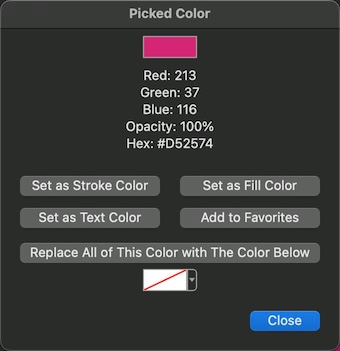
The Picked Color panel appears, showing the color's Red, Green, Blue, Opacity percentage, and Hex value, with options to:
- Set it as the stroke or border color.
- Set it as the fill color.
- Set it as the text color.
- Add it to your favorite colors.
- Replace All of This Color with the Color Below — pick a replacement color in the well at the bottom, then apply. Choosing the transparent color here removes the picked color, which is a quick way to delete a background.
Click Close or press Return to dismiss the panel.
Tips
Sample a solid background color and replace it with the transparent color to quickly remove the background.
Warning
Replace All flattens your layers. It works on the flattened composite of the whole image, and afterwards your layers are replaced by a single image object (or a flat background color). If you only want to change the background image, the app asks you to confirm and offers to limit the replacement to it — choose that option to keep your layer stack. Either way, undo is available.
Tips
The eyedropper samples the merged image, not an individual layer, and zoom does not change the value it reads. To pick a color from one specific layer, make sure the other layers are hidden or transparent first.
Gradient Tool
Add a gradient to the canvas. In the Attributes panel, choose Linear or Radial, then click and drag on the canvas to draw the gradient rectangle.
- Linear gradients sweep in a straight line; Radial gradients radiate from a center point.
- Click once without dragging to add a default-sized gradient.
- A brand-new gradient starts as a plain black-to-gray ramp, so open the gradient well to pick real colors.
Once drawn, use the knobs on the canvas to adjust it:
- The angle knob sets the direction. Hold
Shiftwhile dragging it to snap to 45° increments. A live readout shows the angle in degrees. - The center knob (radial only) moves the gradient's center, and is constrained to stay inside the shape.
- The gradient's angle is stored relative to the object's own rotation, so rotating a gradient rotates its gradient with it.
Tips
- Click the gradient strip in the gradient editor to add a color stop; its color is interpolated from the gradient so it blends in seamlessly. Drag a stop to move it, or drag it off the strip to remove it. A gradient needs at least two stops, and at least three before you can delete one.
- Reverse flips the gradient end to end. Save your own gradients with the
+button (duplicates are rejected), and remove custom ones by right-clicking them. - To apply a gradient to other shapes such as circles or stars, draw the shape first, then set its Fill attribute to Gradient. The same applies to text and to strokes — gradient and pattern are separate fill sources, and picking one clears the other.
Airbrush Tool
Simulate painting with an airbrush. Click and drag to spray color. The longer you hold the brush in one spot, the denser the paint becomes, because the spray builds up from many overlapping dots. Adjust the color and Spray Radius in the Attributes panel.
Tips
- The spray radius has a minimum of 8 points, so the airbrush is always a soft, wide brush — it cannot make a fine line.
- Spray dots are always hard-edged, so a very small radius can look speckled rather than smooth.
- An airbrush stroke has no control knobs for reshaping. To change its size, select it and use the resize knobs, or see Edit Image to modify it as a whole.
Fill Tool
Fill an area with a solid color. Click to fill the contiguous region of matching color around the point you clicked.
Tips
- To include similar-looking neighbors, press and hold, then drag: a red circle and a percentage hint show the current tolerance, and the filled region updates live as you drag. Release to apply. Drag farther to widen the range.
- The fill samples all layers merged together, not just the active layer. Hide layers you don't want to affect.
- A fill that covers a large part of the canvas is added as its own layer and locked automatically to keep editing responsive. Choose Object > Unlock All Objects (
⌃⇧L) if you want to select and adjust it later. - The Fill attribute for this tool is solid-color only.
Line Tool
Draw straight lines. Click and drag to draw; a length hint appears while you draw (and while you drag either endpoint afterward). You can customize the line's color, width, dash style, and add arrowheads in the Attributes panel.
Tips
- Hold
Shiftwhile drawing to constrain the line to horizontal, vertical, or 45°. HoldShiftwhile dragging an endpoint knob to keep the constraint. - Line supports arrowheads at the start, the end, or both.
- After drawing, drag the square knob at either end to adjust the line.
Polyline Tool
Draw a shape composed of multiple straight line segments. Click to add each point; the last segment follows your pointer. Double-click or right-click to finish the shape. Press Esc while drawing to discard the polyline. Drag the control knobs to adjust individual points.
Tips
- Hold
Shiftwhile adding a point to constrain the segment to horizontal, vertical, or 45° angles. - Hold
Option(⌥) while adding a point to turn that segment into a smooth curve. - After finishing, drag any point knob to reshape the polyline.
- The segment you are currently dragging is the one
Shiftconstrains — each segment is constrained relative to its own start point.
Warning
If you hold Option to curve a segment but it still comes out straight, the segment was probably too short. Very short segments are treated as pointer jitter and skipped. Give the segment a little more length and try again.
See Polyline Tool for detailed techniques and practical examples.
Curve Tool
Draw smooth, curved lines. It works similarly to the Line tool, but creates a curve between the points.
After drawing, the curve shows two round control-handle knobs with a guide line through them, plus square endpoint knobs:
- Drag an endpoint knob to move the ends.
- Drag a round handle to bend the curve. The two handles move independently — they are not mirrored like the Vector Pen's.
- Hold
Shiftwhile dragging to constrain, and holdOptionto invert snapping. - Double-click a handle onto the straight line between the endpoints and its guide line hides, because the curve is straight even though the handles are not.
Rectangle Tool
Draw rectangles and squares. Click and drag to define the size, or click once to add a default-sized 100-point square (it scales with your display). A size hint appears while you drag. Use the control knobs to resize it.
Tips
Hold Shift while drawing to constrain the shape to a perfect square.
Round Rectangle Tool
Draw rectangles with rounded corners. After you draw the shape, an additional control knob appears on the canvas to adjust the corner radius directly.
Tips
- Hold
Shiftwhile adjusting the corner radius to make the corners perfectly circular. - The last radius you set becomes the default for new round rectangles. The first one you draw starts at a 20-point radius.
- Pressing
Escwhile dragging the radius knob discards the change and does not update that remembered default.
Ellipse Tool
Draw ellipses and circles. It works exactly like the Rectangle tool.
Tips
Hold Shift while drawing to constrain the shape to a perfect circle.
Shape, Icon, and Emoji Library
Paint S includes a content library with built-in shapes, thousands of icons and emoji, your own imported images, and canvas objects you favorite.
To open the Library:
- In the toolbar, click the Shape segment of the tools control (its tooltip is "Shape, Icon, Emoji…").
- Choose Tool > Shape, Icon, Emoji… (
⌥N) from the menu bar. - To import or reuse images, click the Add Image toolbar button, or choose Object > Import Image… (
⌥I). The Library opens at its Imports section.
The left sidebar lists its sections: Recent, Favorites, Imports, Shapes (42 built-in shapes, including the basic figures), Fluent UI Icons, Material Symbols (18 categories), and Noto Emoji (13 categories). Recent and Favorites only appear once they have items; Imports is always listed so you know where to add your own images. Type in the search field to filter the library by name — matching a category name shows that whole category.
Tips
Shapes and icons insert differently. Picking a shape switches to it as your drawing tool — nothing is placed on the canvas yet, so click and drag to draw it. Picking an icon or emoji inserts it immediately as an object at the center of the visible area, which you then move, resize, or transform.
Insert an Item
- Shapes: Selecting a shape switches to it as your drawing tool. Then click and drag on the canvas to draw it, just like the Rectangle tool. For closed shapes you can also click once to place a default-sized one; arrows and freeform polygons must be dragged.
- Icons, emoji, favorites, and imported images: Double-click an item, or select it and click OK (or press
Return), to insert it directly onto the canvas as an object. It appears at the center of the visible area; then move, resize, or transform it as needed. - Click Cancel or press
Escto close the Library without inserting.
Tips
Single-color vector icons that use the currentColor placeholder are tinted with your current fill color or gradient when inserted. Recolor any placed single-color icon later in the Fill attributes.
Tips
- Recent records the items you pick, automatically, up to 15. Favorites holds up to 100 and is toggled with the star on each item's cell.
- To reuse something you already drew, right-click it on the canvas and choose Add to Favorites, then pick it from Favorites in the library to place it again. Crop layers, fills, and hidden objects can't be favorited this way, but groups and locked objects can.
- Import Image accepts PNG, JPEG, TIFF, BMP, GIF, JP2, PDF, SVG, WebP, HEIC, PSD, PICT, ICO, and ICNS. Imported images are self-contained copies, so the original file can be moved or deleted afterwards. Note that PostScript (
.ps/.eps) is deliberately not supported.
See Content Library for details on favorites, importing, deleting items, and reusing canvas objects.
Vector Pen Tool
Create precise custom paths, curves, and shapes using vector points. In the Tool menu, this tool is named Vector Pen.
- Straight Lines: Click to add anchor points.
- Curves: Click and drag to create a curved segment with direction handles. The handles of adjacent segments mirror each other for a smooth transition. You can also hold
Optionwhile clicking to place a curved point. - Finish Path: Double-click, right-click, or click back on the starting point (a "Click here to end" tip appears when you are close to it) to complete the path.
While drawing, press Delete to remove the last segment and keep drawing, or press Esc to drop the last segment and finish the path. Hold Shift to constrain segments to horizontal, vertical, or 45° angles.
To draw a simple polyline with this tool, just click point by point without dragging, then double-click or right-click to finish.
To convert a path to a shape, select it, right-click it to show the context menu, then choose Close Path.
To edit a finished path, select it: editing knobs appear on every point. Then:
- Press
Deleteto remove the selected point. - Double-click on the line to insert a new point at that position.
- Double-click an existing point to switch it between straight and curved.
See Vector Pen Tool for detailed techniques and practical examples.
Tips
- Closing the path is what makes it fillable. An open path is stroke-only; close it with Close Path to give it a fill. The same menu item opens a closed path back up.
- The two control handles of a curve mirror each other, so bending one bends its neighbor smoothly. Hold
Optionwhile dragging a path point to invert snapping. - A path can be renamed in the layer list, and its points edited non-destructively at any time.
Pen Tool
Use the Pen tool to draw freehand lines, just like sketching on paper with a pencil. You can also use it for pixel painting.
In addition to the line attributes, the Pen tool has one more attribute: the pen shape. There are two shapes, square and round. Use the square shape when pixel painting.
To use this tool, press and hold on the canvas, then drag to draw. Release the mouse button to stop drawing. A single click (without dragging) stamps one dot in the current pen shape.
Tips
If you want to sketch continuously without lifting the stroke when you release the mouse button, hold Shift while drawing. Then you can move to another point and click again to continue drawing.
Info
Your stroke is smoothed automatically when using this tool. If you don't want this, hold Option (⌥) while drawing.
Tips
- For true pixel art, use the square pen shape and turn Smooth off in the Attributes panel. Smooth controls anti-aliasing, so with it on your hard-edged pixels will look blurred.
- The Smooth checkbox is about edge smoothing, not curve fitting. To draw a raw, unsmoothed line, hold
Optionat the moment you start the stroke. - Pen also supports dash styles and arrowheads.
Eraser Tool
This tool helps you erase parts of the image.
You can use it just like the Pen tool.
Info
Unlike the Pen tool, the Eraser always follows your pointer exactly and never smooths the stroke. This gives you precise control when erasing.
Tips
- An eraser stroke is a real layer, but it cannot be clicked or selected on canvas — manage or delete it from the layer list. It has no color and no dash style.
- Just like the Pen, holding
Shiftas you release lets you continue the same stroke without lifting. - The Eraser's Smooth setting is remembered between launches, unlike the Pen's.
Text Tool
The Text tool helps you add text to the canvas.
In addition to all the attributes of a shape, such as border attributes and fill attributes, text has its own text attributes.
To use this tool, click on the canvas to add an auto-resizing text box and start typing. The size of the text box is adjusted automatically to fit the text content.
You can also press and drag on the canvas to add a text box with a fixed size that you define. You need to adjust its size manually.
Tips
You can change the auto-resizing attribute of a text box in the Attributes panel at any time.
To edit the text of an existing text box, select it with the Select and Move tool, then double-click it, press the Return key, or right-click it and choose Start Typing to start editing.
Tips
You can also paste emoji and symbols into your text. While editing, use the standard macOS Edit > Emoji & Symbols shortcut, or copy and paste characters from another app.
To finish editing, press the Esc key, or right-click the canvas to show the context menu and choose End Editing.
Info
If you finish editing a brand-new text box without typing anything, it is removed automatically.
Tips
- Auto-resizing boxes grow from the top-left corner, so the text stays anchored as it wraps. A box you drew too small to fit even one character automatically becomes auto-resizing.
- If you clear an existing text box to empty, it is removed — unless it has a border or background and is set to a fixed size, in which case the empty box is kept so you can type into it again.
- Fonts smaller than 9 points are raised to 12 points while you type, and a nearly transparent text color is made solid, so your text is actually visible while editing.
You can also add curved text. See Curved Text for details.
Crop Tool
This tool helps you crop the canvas image.
After choosing this tool, a crop rectangle is added to the canvas automatically. It reuses your current selection, or your previous crop area if the canvas size has not changed, as long as the area is fully visible; otherwise it covers the middle of the visible canvas. The area outside the crop rectangle is dimmed so you can preview the result.
You can drag the crop rectangle or its control knobs to adjust it, or enter exact position and size values in the Attributes panel.
To apply the crop, double-click inside the crop rectangle, or right-click the canvas to show the context menu and choose Crop. You can also choose Image > Crop (⌘K). Press Esc to cancel.
Tips
- Cropping keeps your layers as layers — it does not flatten your image. Objects outside the crop rectangle are moved out of view rather than deleted, so a single undo brings everything back.
- Hold
Shiftwhile dragging a corner or edge knob to keep the crop's aspect ratio.
Selection Tool
This tool helps you select part of the image on the canvas. There are 4 selection tools:
Rectangular Selection tool
You can use it just like the Rectangle tool to select a rectangle area. This is the default and most commonly used selection tool.
While you drag, objects inside the rectangle are highlighted, so you can grab them with the Select and Move tool right away.Elliptical Selection tool You can use it just like the Ellipse tool to select an elliptical area. It starts from the center: press where you want the center of the ellipse to be and drag outward.
Lasso Selection tool You can use it to select a free-form area. Just press and hold at a point on the canvas and drag to select. Release the mouse button and the path closes automatically.
Polygonal Selection tool You can use it to select a free polygon area, point by point. Double-click or right-click to finish; the selection closes automatically.
You can choose one of them in 3 ways:
Choose a selection tool from the Tool > Selection menu.
Click the Selection tool icon in the toolbar and hold it down to pop up the selection menu. Release when the tool you want is highlighted.
This is the fastest way to choose a selection tool.Click the Selection tool icon in the toolbar to select it, then click the selection button in the Attributes panel to choose a selection tool.
Tips
To select the whole image, choose the Edit > Select All menu in the menu bar.
After selecting an area, you can edit the selected area, including delete, cut, copy, rotate, flip, adjust opacity, invert colors, adjust colors, apply a filter, and so on. See Edit Image for details.
Tips
Right-click the selection for quick commands: Crop to Selection crops the canvas to it, Invert Selection switches to everything outside it, and Slice Selection lifts the selected pixels onto a new layer.
Tips
After selecting an area on the canvas, hold Shift (or Command) and then drag the selection to move the image inside it instead of moving the selection frame.
Warning
Moving the image out of a selection this way cuts the pixels out of the canvas and places them on a new layer — it is not a temporary preview drag. The selection frame itself cannot be moved while it is inverted, and the Lasso and Magic Selection frames are fixed in place and cannot be dragged at all.
Magic Selection Tool
This tool also helps you select an area on the canvas.
To use it, press and hold at a point on the canvas, then drag to expand the selection over an area with a color similar to the clicked point. While you drag, a red tolerance circle and a percentage hint show how wide the color match is, and the selection updates live. The further you drag, the more connected points are selected.
Tips
The selection grows through connected pixels only, so it will not jump across a gap of contrasting color. To include a region that is only loosely connected, drag a much larger circle.
After selecting an area, you can edit the selected area, including delete, cut, copy, rotate, flip, adjust opacity, invert colors, adjust colors, apply a filter, and so on. See Edit Image for details.
Tips
You can use this tool to select and remove the image background. Just press and hold at a point on the background, then drag to select all the area you want, and press the Delete key to remove it. The selection stays active afterward, so you can immediately select and delete another region.
Tips
A Magic Selection has no frame you can drag or resize — to change its extent, draw a new one.
Select and Move Tool
This tool helps you select objects on the canvas. It is the most commonly used tool. It differs from the Rectangular Selection tool, which selects an area of the canvas. You can use it just like the Rectangular Selection tool, and all objects inside the selected area are selected.
Tips
To select more than one object, hold down Command or Shift and click the objects you want to select. With Command or Shift held, clicking an already-selected object removes it from the selection.
Tips
To select all objects on the canvas, choose the Edit > Select All Objects menu in the menu bar.
Info
- Right-clicking selects the object under the pointer first, then shows the context menu for it.
- Double-click a group to select the object inside it.
- Locked objects and objects with very low opacity (below 2%) can't be clicked. Unlock them first (Object > Unlock All Objects) to select them.
- If you release a drag at exactly the point where you started it, the move is canceled.
After selecting objects, you can manage and edit them, including delete, cut, copy, rotate, resize, flip, align, distribute, group, ungroup, apply a filter, and so on. See Manage Layers and Objects for details.
Tips
- Grouping and arranging live in the Object menu: Group Selected Objects (
⌃G), Ungroup Selected Groups (⌃⇧G), Flip Horizontally (⌥H), Flip Vertically (⌥V), Rotate & Resize (⌘R), Transform (⌘T), and the Align and Distribute submenus. Relative Align and Distribute need at least two objects selected; equal-spacing Distribute needs three. - Align to canvas works with a single object selected, which is a quick way to center something without making a rectangular selection first.
- The whole canvas can be flipped independently of its contents via Image > Flip Canvas Horizontally / Vertically.