Edit Image
You can edit the entire image or specific selections using commands from the Image and Object menus.
Info
Editing commands apply to the selected area when one exists. Otherwise, they apply to the selected object, or to the whole image when nothing is selected.
Warning
Several of these commands merge your layers into a single image. That is undoable with ⌘Z, but once you undo past it the individual objects are gone for good. When a command is about to merge, the app normally asks first.
Delete
Select an area with a Selection Tool, then press the Delete key or choose Edit > Delete.
Tips
With a selection active, Delete doesn't remove objects — it adds a new transparent layer that clears the selected pixels, so the result stays editable. Deleting a rectangular selection that covers the entire canvas resets the document instead. To delete objects, select them with the Select and Move tool first.
Copy
Select an area, then choose Edit > Copy or press Command + C.
Tips
Copying an object also remembers its drawing style. Select other objects and choose Edit > Paste Drawing Style (⇧⌘V) to apply the same colors and attributes to them. See Copy and Paste Drawing Style.
Crop
Choose Image > Crop (⌘K) to activate the Crop Tool. Adjust the crop area, then double-click inside it, or right-click the canvas and choose Crop. Press Esc to cancel.
Resize Canvas
Choose Image > Resize Canvas… (⌃S) to resize the canvas or the image.
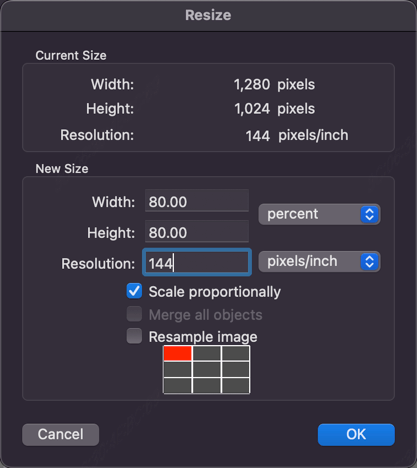
In this panel, you can adjust:
- Current Size: Shows the present dimensions of your document.
- Dimensions: Enter a new width and height. Available units include pixels, percent, inches, cm, mm, and feet.
- Resolution: Set the image resolution in pixels per inch or pixels per centimeter.
- Scale proportionally: Keep this checked to maintain the original aspect ratio when changing dimensions.
- Merge all objects: Flattens all layers into a single image during resizing. It is recommended to leave this unchecked to preserve editability.
- Resample image: When checked, the image content is scaled to the new dimensions. When unchecked, only the canvas size changes, and a 3 × 3 anchor grid appears: click a cell to choose where the original image sits within the new canvas.
Click OK to apply, or Cancel to discard.
Tips
- Turn Scale proportionally back on at any time and the panel resets — the size returns to the original dimensions and the resolution to its original value.
- The anchor grid's default position is the top-left, not the center, so an expanded canvas keeps the original image in the top-left corner until you click another cell.
- Changing only the resolution updates the document's DPI and the rulers without touching your layers. It does not rescale text or strokes.
Warning
The Merge all objects checkbox is not freely adjustable — it follows the other two options. With Resample image off, merging is forced off (objects are only repositioned, never scaled). With Resample on and Scale proportionally off, merging is forced on, because a non-uniform scale can't be applied to separate layers. You only get the choice when both are on.
Adjust Opacity
Choose Image > Adjust Image Opacity… (⌃O) to change the transparency of the entire image. To adjust a specific area, select it first, then choose Object > Adjust Opacity… (⇧⌃O). Both open a small options window with a slider, a number field, and stepper buttons, plus a live preview; click OK to apply or Cancel to discard.
Tips
- The value runs from 0 to 100, and you can type an exact number. Setting a selection back to 100% counts as "no change", so no undo step is created for it.
- Adjusting a selection creates two new layers — the cropped pixels plus a transparent mask — rather than modifying existing objects.
Warning
When the whole image contains more than one layer, ⌃O asks whether to merge them before proceeding. If the background is an image you get a three-way choice: only the background, merge everything and continue, or cancel. Choose "only background" to keep your layer stack intact.
Rotate
Choose Image > Rotate Canvas Left (⌃←) or Rotate Canvas Right (⌃→) to rotate the entire document. To rotate a specific element, select it and choose Object > Rotate & Resize… (⌘R).
Important
Rotating the canvas merges all layers into a single image, and swaps the canvas width and height — a 100 × 200 document becomes 200 × 100. To transform one object while keeping layers editable, use the Object menu instead.
Flip
Choose Image > Flip Canvas Horizontally (⌃⌘H) or Flip Canvas Vertically (⌃⌘E). For specific elements, select them and use the Object menu (Flip Horizontally ⌥H / Flip Vertically ⌥V).
Important
Flipping the canvas merges all layers into a single image, but keeps the canvas dimensions unchanged.
Tips
If you want to flip the image but keep your layers, use the Object menu instead — it flips the object and leaves the rest of the document intact.
Adjust Colors
Choose Image > Adjust Colors… (⌃C) to modify the entire image. For a specific area, select it and choose Object > Apply Effect > Adjust Colors.
A settings window (titled with the effect's name) opens with a slider, a number field, and stepper buttons for Exposure, Saturation, Contrast, Brightness, Highlights, Shadows, Sepia, Hue, and Gamma. The image previews live as you drag:
- Every control shows its current value, and you can type an exact one. Neutral is 100% for Saturation, Contrast, and Highlights; 0% for Brightness, Shadows, and Sepia; 0 EV for Exposure; 0° for Hue; and 1.00 for Gamma. Exposure is measured in EV, Hue in degrees (−180° to 180°), and Gamma is a plain multiplier.
- The stepper buttons move one fixed step at a time — 0.05 EV, 1% for Saturation and Contrast, 5% for the other percentage controls, 1° for Hue, and 0.01 for Gamma — so you can note a setting down and reproduce it later. Values you type are clamped to each control's range.
- Press
Returnin a number field to apply what you typed; the window stays open.Tabor clicking away does the same and moves focus on. - Click OK to apply, or Cancel to discard.
- Use the gear menu to revert to the settings the panel opened with, or to reset everything to its default, and click + to save the current numbers as a favorite. Favorites are listed in the same menu, per effect, and are offered again next time.
- The adjustment is added as an effect object. Double-click it later to reopen its settings window and fine-tune the values.
Invert Colors
Choose Image > Invert Colors (⌃V). For a specific area, select it and choose Object > Apply Effect > Invert Colors. This effect has no parameters and applies instantly.
Apply Effects
Select an area (or choose Edit > Select All), then choose Object > Apply Effect to add filters and visual effects. The menu is ordered as follows, and the first few also have shortcuts:
| Effect | Shortcut | Has settings? |
|---|---|---|
| Straighten | ⌥⌘T | no |
| Adjust Colors | ⌥⌘A | yes |
| Invert Colors | ⌥⌘I | no |
| Black And White | — | no |
| Blur | ⌥⌘B | yes |
| Sharpen | ⌥⌘S | yes |
| Crystallize | — | yes |
| Pixellate | — | yes |
| Pointillize | — | yes |
| Edges | — | yes |
Tips
- Effects with adjustable strength (Blur, Sharpen, Crystallize, Pixellate, Pointillize, Edges) open a settings window with a slider, a number field, and stepper buttons, with live preview, just like Adjust Colors. Blur, Crystallize, Pixellate, and Pointillize show their size in pixels; Sharpen and Edges show a plain strength number. Type an exact value or note one down to reproduce it later. Double-click the effect object later to reopen it.
- Invert Colors, Black And White, and Straighten apply instantly without a settings window. Because they have nothing to tune, applying Invert Colors twice to the same object creates two layers that cancel each other out visually.
- Choosing the same effect again on an existing effect layer reopens its settings instead of stacking a duplicate. Choose a different effect to stack another layer on top.
- Blur, Crystallize, Pixellate, Pointillize, and Edges pad the layer with a transparent border so the filter doesn't fade out at the object's edges; Sharpen and Edges do not, so they can darken the outermost pixels.
Straighten
Choose Image > Straighten (⌃T) to straighten the background image, or select an image object and choose Object > Apply Effect > Straighten (⌥⌘T). The app asks macOS to analyze the image and auto-adjust it in one step — which can include straightening, cropping to the salient area, and correcting levels. There are no manual controls. If the result isn't what you want, undo it and rotate the image manually with Object > Rotate & Resize….
Warning
How Straighten behaves depends on how many visible objects you have. With only the background image, the whole document is replaced and the canvas takes the new image's dimensions. With two or more visible objects, only the background bitmap is swapped — your layers survive, but the canvas size stays fixed and the straightened result is scaled to fit it. On the Object path, the frame is preserved instead, and you need to press ⌘Z twice to undo it fully.
Replace Colors
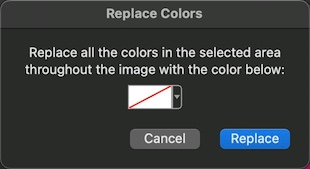
Select an area, then choose Image > Replace Selected Colors… (⌃R). The app collects every color found in the selection and shows the Replace Colors window. Pick the replacement color there and click Replace: those colors are then replaced throughout the entire image, not only inside the selection. If the color you picked matches the one selected, nothing happens and the app tells you so.
Tips
Choose the transparent (clear) color as the replacement to erase those colors—and quickly remove a solid background. The replacement color is remembered for next time, and progress is reported while it works.
Warning
Replacing colors flattens the document into a single image layer unless the background image is the only visible thing, or unless you choose Only Background when asked. Choose that option to keep your layers.
Tips
Because the app collects every distinct color in the selection before replacing anything, a large selection over a photograph can take a while and shows a progress indicator.
Remove Background
Choose Image > Remove Background (⌃B) to automatically detect and remove the image background using AI. If the automatic removal cannot find a clear background, you can use the Magic Selection Tool to select and delete it manually.
Important
Requires macOS 14 (Sonoma) or later.
Tips
This command applies to the entire document and ignores any active selection. To remove the background of a specific layer, select the layer and use Object > Remove Background (which has no keyboard shortcut).
Tips
The background is replaced with a version that keeps the original image size, with the background areas made transparent — the result is not cropped tightly to the subject, so you may want to crop afterwards. Undo restores the original image.